G-255 turns the worlds largest balance sheets into daily tradeable alpha.

Simple. Fast. Institutional-grade. G-255 turns the world’s largest balance sheets into daily tradeable alpha.

About The G-255 Systematic Trading Model

SYSTEMATIC CREDIT AND EQUITY TRADING– is a rule-based approach to investing in fixed income markets—specifically corporate bonds—that uses a series of algorithms rather than traditional fundamental analysis to make decisions.

Simple. Fast. Institutional-grade. G-255 turns the world’s biggest balance sheets into daily tradeable alpha.

It uses a purely systematic, stochastic absolute value model with zero human input: signals derive solely from each issuer’s own 52-week public pricing history (plus earnings and balance sheet/leverage data). No peer comparisons, forecasts, macro factors, or sentiment analysis. This issuer-isolated approach detects extreme trading levels vs. each name’s historic norms, covering ~85% of daily TRACE-reported USD corporate bond trades (95% IG, 48% HY). Back-tested tracking accuracy: 97.5%.

The G-255 trading model is a fully systematic, cross asset trading model created by Larry Domash to deliver consistent, transparent, and repeatable trade indicators across global credit and equity markets. The model operates on a simple principle: use only what every investor can access – government-mandated financial disclosures and observable market prices – and transform that information through a proprietary framework that reveals valuation and trading opportunities with unmatched precision.

The automated model links equity (growth, volatility, momentum) and bond (credit spreads, debt dynamics) data from each issuer’s history, spotting divergences (e.g., equity momentum vs. spread moves) to generate objective long/short indicators across both asset classes. The G-255 systematic trading model uses only publicly available information and does not forecast. It simply reacts to what companies actually report: cash flow, leverage, revenue momentum, and capital returns

What are G-255 Indicators 

G-255 INDICATORS– In the context of systematic credit and equity, the G-255 refers to a specific group of high volume, liquid U.S. corporate bond issuers often used as a benchmark for market activity. It is comprised of the top 96 of the top 100 traded issuer bonds, which can account for roughly 97% OF THE TOP 100 ISSUER VOLUME and a significant majority (over 75%) of total TRACE (Trade Reporting and Compliance Engine) volume. Systematic traders use the G-255 as a proxy for broad market health and liquidity. Because these issuers are highly liquid, they allow systematic models to execute large trades with lower transaction cost, which is critical for algorithmic strategies.

Systematic Trading Model Statistics for March

Lorem Ipsum is simply dummy text of the printing and typesetting industry. Lorem Ipsum has been the industry’s standard dummy text ever since the 1500s.

G-255 Credit

Total Issuers:

255

G-255 Credit Bonds in issue:

6,021

G-255 Credit Trading MKT Cap $B:

$6,964,904

G-255 Credit Bonds in issue:

6,021

G-255 Credit Trading MKT Cap $B:

$6,964,904

Re-levering Issuers:

144

Re-levering Market Capital:

$3,769,845

Long Credit Indicators:

92

Long Credit Market Cap $B:

$169,415

Undervalued Credit Indicators:

66

Undervalued Credit Market Cap $B:

$118,046

Short Credit Indicators:

131

Short Credit Market Cap $B:

$1,121,622

Overvalued Credit Indicators:

287

Overvalued Credit Market Cap $B:

$378,546

Most Long Credit Sector:

Single A TMT

Most Short Equity Indicators:

Big 6 Banks
255

G--255 Credit is Overvalued

G-255 Equity

242

Total Issuers:

$48,328,228

G-255 Equities in issue:

$48,328,228

G-255 Equity Trading MKT Cap $B:

229

Equity Issuers growing cash flow:

$45,972,868

Growing Cash Flow Market Cap $B:

27

Issuers with cash flow decline:

$2,409,360

Cash flow decline Market Cap $B:

29

Long Equity Indicators:

$12,279,605

Long Equity Market Cap $B:

22

Undervalued Equity Indicators:

$5,273,533

Undervalued Equity Market Cap $B:

11

Short Equity Indicators:

$1,121,622

Short Equity Market Cap $B:

4

Overvalued Short Equity Indicators:

$378,546

Overvalued Equity Market Cap $B:

Most Long Equity Indicators:

TMT

Most Short Equity Indicators:

Global Auto

G-255 Equities are Overvalued

How to use this chart:

(1) G-255 largest cap Equites show YoY cash flow growth >5% below historic trend
(2) 110 G-255 largest Credit issuers are de-levering 216 bonds trade within 200/0 of 52 week wide spread

(3) 38 global largest cap equites have YoY flow decline, trade above historic trend
(4) 145 global largest corp debt issuers are re-levering 369 bonds are within 15% of 52 wk tight spread

Issuer Equity Price Movement and Credit Spread levels are directly correlated
G-255 Credit

Total Issuers:

255

G-255 Credit Bonds in issue:

6,021

G-255 Credit Trading MKT Cap $B:

$6,964,904

G-255 Credit Bonds in issue:

6,021

G-255 Credit Trading MKT Cap $B:

$6,964,904

Re-levering Issuers:

144

Re-levering Market Capital:

$3,769,845

Long Credit Indicators:

92

Long Credit Market Cap $B:

$169,415

Undervalued Credit Indicators:

66

Undervalued Credit Market Cap $B:

$118,046

Short Credit Indicators:

131

Short Credit Market Cap $B:

$1,121,622

Overvalued Credit Indicators:

287

Overvalued Credit Market Cap $B:

$378,546

Most Long Credit Sector:

Single A TMT

Most Short Equity Indicators:

Big 6 Banks

G--255 Credit is Overvalued

G-255 Equity

Total Issuers:

242

G-255 Equities in issue:

$48,328,228

G-255 Equity Trading MKT Cap $B:

$48,328,228

Equity Issuers growing cash flow:

229

Growing Cash Flow Market Cap $B:

$45,972,868

Issuers with cash flow decline:

27

Cash flow decline Market Cap $B:

$2,409,360

Long Equity Indicators:

29

Long Equity Market Cap $B:

$12,279,605

Undervalued Equity Indicators:

22

Undervalued Equity Market Cap $B:

$5,273,533

Short Equity Indicators:

11

Short Equity Market Cap $B:

$1,121,622

Overvalued Short Equity Indicators:

4

Overvalued Equity Market Cap $B:

$378,546

Most Long Equity Indicators:

TMT

Most Short Equity Indicators:

Global Auto

G-255 Equities are Overvalued

What are G-255 Indicators 

G-255 INDICATORS– In the context of systematic credit and equity, the G-255 refers to a specific group of high volume, liquid U.S. corporate bond issuers often used as a benchmark for market activity. 

Key Systematic Trading Indicators for February 27

Lorem Ipsum is simply dummy text of the printing and typesetting industry. Lorem Ipsum has been the industry’s standard dummy text ever since the 1500s.

Long Credit Indicators: -13 to 92/ Short Credit Indicators: -73 to 1311

Long Equity Indicators: -2 to 51/ Short Equity Indicators: unchanged @ 11

G-255 Credit Trade Allocation:40% long de-levering issuers / 20% Front end FRN / 40% short re-levering Issuers

G-255 Equity Trade Allocation:65% long issuers with YoY cash flow growth / 35% short issuers with declining cash

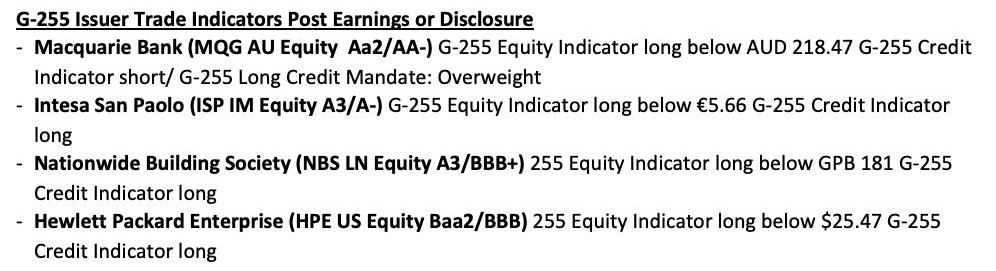
Goldman Sachs GS 2.6 02/07/30 (short trade indicator) reaches fair value

CVX 4.687 04/15/30 and E 5.7 04/01/35 both added as G-255 credit trading model basket trade shorts

US IG Corporate Bond Mutual Fund inflow declined for a second straight week. HY Corporate fund outflow

Credit Market Conditions

Source: Bloomberg Capital Markets / Jan 23, 2026 was the peak in G-255 credit short trade indicators (1.384)

Equity Market Conditions

[equity_tables_carousel]

Source: Bloomberg Capital Markets

Lorem Ipsum is simply dummy text.

At its core, G-255 is purely systematic and has no human characteristics whatsoever:

Simple. Fast. Institutional-grade. G-255 turns the world’s biggest balance sheets into daily tradeable alpha.

It uses a purely systematic, stochastic absolute value model with zero human input: signals derive solely from each issuer’s own 52-week public pricing history (plus earnings and balance sheet/leverage data). No peer comparisons, forecasts, macro factors, or sentiment analysis. This issuer-isolated approach detects extreme trading levels vs. each name’s historic norms, covering ~85% of daily TRACE-reported USD corporate bond trades (95% IG, 48% HY). Back-tested tracking accuracy: 97.5%.

The G-255 trading model is a fully systematic, cross asset trading model created by Larry Domash to deliver consistent, transparent, and repeatable trade indicators across global credit and equity markets. The model operates on a simple principle: use only what every investor can access – government-mandated financial disclosures and observable market prices – and transform that information through a proprietary framework that reveals valuation and trading opportunities with unmatched precision.

The automated model links equity (growth, volatility, momentum) and bond (credit spreads, debt dynamics) data from each issuer’s history, spotting divergences (e.g., equity momentum vs. spread moves) to generate objective long/short indicators across both asset classes. The G-255 systematic trading model uses only publicly available information and does not forecast. It simply reacts to what companies actually report: cash flow, leverage, revenue momentum, and capital returns

What are G-255 Indicators 

G-255 INDICATORS– In the context of systematic credit and equity, the G-255 refers to a specific group of high volume, liquid U.S. corporate bond issuers often used as a benchmark for market activity. It is comprised of the top 96 of the top 100 traded issuer bonds, which can account for roughly 97% OF THE TOP 100 ISSUER VOLUME and a significant majority (over 75%) of total TRACE (Trade Reporting and Compliance Engine) volume. Systematic traders use the G-255 as a proxy for broad market health and liquidity. Because these issuers are highly liquid, they allow systematic models to execute large trades with lower transaction cost, which is critical for algorithmic strategies.

FAQs

Lorem Ipsum is simply dummy text of the printing and typesetting industry. Lorem Ipsum has been the industry’s standard dummy text ever since the 1500s.

What are the 3 different types of G-255 Systematic Portfolio Daily Credit Trading Model Indicators
  • Long Indicators: Are de-leveraging credits issues with attractive valuations as well as new supply of G-255 issuers. Long Indicators target G-255 issuers with positive year-on-year cash flow, trading more than 7.5% below their historic price and moving averages. Long Indicators also focus on issuers with the largest capital returns to shareholders.

  • Short Indicators: Are re-leveraging issuers trading within 10% of their 52-week tight credit spread. Short Indicators target G-255 issuers with negative year-on-year cash flow and returns to shareholders, trading more than 7.5% above their historic price moving averages and focus on issuers with the largest declines in operating cash flow.

  • New Issue Supply: The G-255 trading model creates new issue long trade indicators for all new USD sold by G-255 issuers. G-255 New Issue Trading Process & Reports
  • The G-255 systematic trading model provides daily credit trade indicators for new USD bond offerings from the world’s 255 largest corporate issuers (≥$15 billion in tradable debt). The new issue process and reporting are designed to help institutional investors identify attractive entry points, track performance, and compare systematic selectivity against traditional buy-and-hold strategies. The G-255 new issue framework offers a quantitative, issuer-specific lens on pricing attractiveness and post-launch performance, helping investors avoid overpaying for new supply, capture early tightening opportunities, and document long-term alpha from systematic credit selection in a higher risk-premium environment. All indicators are generated from public data with zero human input and are liquidity-filtered for institutional-scale trading. For full historical tables and current weekly recaps, refer to the attached G-255 new issue reports or Curve Publishing updates.
  • G-255 represents the 255 largest global issuers of corporate debt (primarily in USD, GBP, and EUR), each with at least $15 billion in liquid, tradable debt. This universe covers:

    • Approximately 6,000 USD-denominated bonds (average ~$1.16 billion per bond).

    • Around 242 publicly listed equities (combined market cap ~$47 trillion, with many non-U.S. domiciled issuers).

    • It captures a significant portion (often estimated at 66%+) of trading volume and market cap in major corporate debt markets.

    The model tracks these issuers exclusively, using issuer-specific data only (no macro factors, peer comparisons, or sentiment inputs).

The system is a fully automated, stochastic (probability-based) credit and equity trading model that:

  • Recalibrates daily using publicly available data (pricing, balance sheets, cash flows, leverage, shareholder returns).

  • Generates long and short trade signals (buy/hold or sell/short) for individual issuers’ bonds and stocks.

  • Focuses on issuer fundamentals:

o Credit (bonds): Signals based on de-leveraging (improving balance sheets, undervalued spreads) vs. re-leveraging (increasing debt, overvalued spreads). It highlights attractive valuations, new bond supply opportunities, and divergences.

o Equity: Targets positive/negative year-over-year cash flow trends and shareholder returns.

  • Integrates cross-asset signals: Links bond credit spreads with equity performance (e.g., strong equity cash flows but widening credit spreads → potential long signal).

  • Includes liquidity thresholds for actionable trades on electronic platforms.

  • Provides sector-specific breakdowns (e.g., TMT, Healthcare, Banks) and portfolio-level indicators (e.g., long opportunities in undervalued bonds worth hundreds of billions).

It’s back-tested over 35+ years with high tracking accuracy, emphasizing objective, data-driven assessments without human bias.

The G-255 trading process is designed for systematic trading on electronic platforms for equities and bonds. The system accommodates the largest institutional trade sizes, dependent on the users resources and trading relationships (all G-255 USD corporate bonds trade OTC via over 80 dealers and all 5 major U.S. electronic bond trading firms). The model analyzes historical relative values across the capital structure, generating indicators for over/undervalued bonds.

This quantitative framework provides trade indicators for global corporate capital structure pricing extremes.

Contact Us

Companies We Focus On

Lorem Ipsum is simply dummy text of the printing and typesetting industry. Lorem Ipsum has been the industry’s standard dummy text ever since the 1500s.

Contact Us